
The Roland P-6 Isn't Perfect. That's Why I Still Use It

When the Roland P-6 first launched, it seemed like everyone was talking about it. Reviews appeared everywhere, people were exploring the granular engine, and it felt like one of the most exciting portable samplers to hit the market in a while. Then, as always happens, new gear arrived. The conversation shifted to the next release, and the P-6 slowly faded into the background.
I'll admit that happened to me, too. As more samplers found their way into my studio, I naturally spent less time with the P-6. It wasn't because I'd stopped liking it. There were simply other workflows I wanted to explore. Recently, though, several of my students wanted to learn the P-6, so I started using it again to refresh my memory. Within a few sessions, I found myself wondering why I'd ever put it aside in the first place.
The Problem with Gear Hype
The music world moves quickly. Every year brings another sampler, synthesizer, or workflow that's supposed to solve all of our creative problems. There's nothing wrong with being excited about new tools, but I think it's easy to mistake a quieter conversation for a less capable instrument.

The reality is that a sampler doesn't become less creative because another one was released six months later. If anything, returning to older gear often reminds me why I bought it in the first place. Once the hype disappears, you're left with the thing that actually matters: does it still make you want to create?
For me, that's the question worth asking every time I consider buying something new. If a piece of gear still inspires me after the excitement has worn off, it's earned a permanent place in my studio.
The Roland P-6 Still Has Something Special
The biggest reason I keep coming back to the Roland P-6 is its granular engine. There are plenty of portable samplers that can chop loops, sequence drums, and trigger samples. Very few in this price range can completely transform a simple recording into something entirely new.
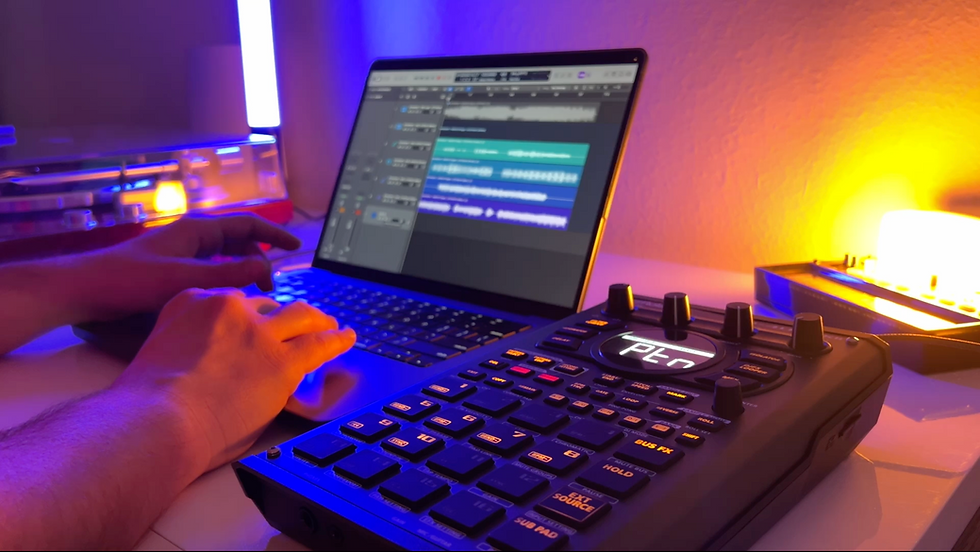
During my livestream, I loaded a short vocal sample into the granular engine with one goal in mind: turning it into an evolving pad. It wasn't an instant process. Granular synthesis on the P-6 takes experimentation, and some of the settings can feel unintuitive at first. But after adjusting grain size, playback behavior, keyboard tracking, and a few effects, the original vocal had become something completely different.
That's what keeps drawing me back. It doesn't just play samples. It encourages exploration. Sometimes the result isn't interesting at all, and sometimes you stumble onto a texture you never would have imagined from the original recording.
Learn how to make the most of the Granular Engine and every feature of the P-6 with my easy to reference Cheat Sheet
Great Gear Doesn't Have to Be Perfect
None of this means I think the P-6 is flawless.
The tiny interface requires more menu diving than I'd like, navigating track mutes isn't always intuitive, and there are still things I'd love Roland to improve. My biggest frustration is the effects routing, where the send effects sit after the bus effects. It limits some of the performance tricks I enjoy using on other samplers, and it's probably the one feature I'd change first if I could.
The sample time is another compromise. If you're planning to build projects around long stereo recordings, the P-6 probably isn't the right tool. It's designed around shorter samples and creative manipulation rather than acting as a large sample library.
Oddly enough, none of those compromises stop me from reaching for it.
Every piece of gear has limitations. What matters is whether its strengths are inspiring enough that you're happy to work around the weaknesses. For me, the P-6 easily clears that bar.
I Stopped Looking for the Perfect Sampler
One realization I've had over the past year is that I don't really want one sampler to do everything anymore.
Instead, I've started thinking about combinations of tools that complement each other. The P-6 works incredibly well alongside something like an SP404 or an MPC Sample. The larger sampler handles longer arrangements, more comfortable sequencing, or performance features, while the P-6 becomes a dedicated sound design tool with its granular engine, gritty sample rates, and Roland effects.
That approach has changed the way I think about buying gear. Instead of asking whether one sampler is objectively better than another, I ask what unique role each one can play in my workflow.
Creativity Lasts Longer Than Hype
One thing I noticed while making music on the P-6 again was how quickly I stopped thinking about specifications. After a few minutes, I wasn't comparing it to other samplers anymore. I was simply making music.
I think that's the point where a piece of gear proves its value. Not when it's trending on YouTube or filling comment sections, but when it continues to inspire you long after everyone else has moved on.
The Roland P-6 isn't the newest sampler on my desk anymore, and it certainly isn't perfect. But every time I pick it up, I find myself experimenting with sounds, discovering new textures, and finishing ideas I probably wouldn't have made any other way.
For me, that's ultimately what makes a piece of gear worth keeping. Long after the hype cycle ends, creativity is the feature that matters most.
Music Making Resources
Free Sampler Starter Kit
Learn chopping, performance techniques, and beatmaking workflows for any sampler.
Get it free when you sign up for my monthly beatmaking newsletter:
Sample Packs
Original recordings made for sampling, chopping, resampling, and turning into something entirely your own.
Personalized Coaching
One-on-one help with beatmaking, music production, workflow development, and finishing tracks:


Comments