
The Blank Page Problem: Why More Options Kill Creativity

One of the biggest mistakes I made in music production had nothing to do with using the wrong gear. For years, I assumed that creative struggles came from missing tools. If I had another synthesizer, another plugin, or a more elaborate setup, surely making music would become easier. But after spending enough time bouncing between different workflows, I realized the problem wasn't a lack of options. In many cases, it was the opposite.
Whenever I sat down in front of a large DAW template loaded with instruments, effects, and endless possibilities, I often found myself staring at a blank project. Meanwhile, some of my most productive sessions happened when I picked up a small sampler, groovebox, or portable instrument with obvious limitations. The contrast became impossible to ignore. The less I had to choose from at the start, the easier it became to actually begin.
The Blank Page Problem in Music Production
Modern music production tools are incredible. Open a DAW and you instantly have access to virtually unlimited tracks, thousands of sounds, advanced effects, and enough processing power to build almost anything you can imagine. On paper, that sounds like the ideal creative environment. In practice, though, all of that freedom can create a surprising amount of friction.
Every decision branches into several more decisions. Before you've written a single note, you're already choosing instruments, presets, effects, drum kits, routing options, and workflow approaches. The result is that your creative energy gets spent evaluating possibilities instead of creating something tangible. What feels like freedom can quickly become hesitation, especially when you're trying to start from nothing.
I've come to think of this as the blank page problem. The issue isn't a lack of inspiration. It's that you're being asked to make too many decisions before the song has had a chance to reveal itself. When every path is available, choosing any one path can feel strangely difficult.
Why Limited Gear Works So Well
One of the reasons I keep returning to small grooveboxes and portable samplers is that they reduce the number of decisions I need to make during those first few minutes. Recently, I sat down with the smallest groovebox I own and started building a track from scratch. Instead of browsing sounds or planning an elaborate arrangement, I began with a simple chord progression and let the rest of the song grow from there.
From those chords, I added a basic drum pattern, a bass line that followed the harmonic movement, and a few melodic layers. Within a short amount of time, I had the foundation of a complete idea. The device itself wasn't doing anything magical. In fact, many of its limitations would probably frustrate someone trying to produce an entire finished record on it. What it did exceptionally well, however, was narrow the decision tree and encourage momentum.
That's the part I think many producers overlook. The value of limited gear isn't that it's objectively better than a computer. The value is that it removes enough choices to make forward progress feel obvious. Instead of wondering what to do next, you simply work with what's in front of you.
Constraints Create Momentum
A lot of musicians view limitations as obstacles to overcome, but I've found they often function as creative accelerators. When there are fewer options available, you naturally spend less time comparing possibilities and more time making decisions. Those decisions may not always be perfect, but they move the project forward.
I've noticed this across almost every piece of limited gear I've owned. When there are only a handful of tracks available, I commit to ideas faster. When there are only a few sounds loaded, I spend more time arranging and less time browsing. When I only have one device in front of me, I'm far less likely to spend half an hour reorganizing my setup instead of making music.
The goal isn't to avoid powerful tools. It's to avoid introducing complexity before you've earned it. Constraints help create momentum, and momentum is often far more valuable than flexibility during the earliest stages of a song.
The Mistake Most Producers Make
I think many of us assume that more features automatically create a better starting point. It's an understandable assumption because powerful tools can solve a lot of problems. The issue is that starting a song and finishing a song are two completely different activities, and they benefit from different environments.
When you're starting, constraints help. You need enough structure to make decisions quickly and enough momentum to discover an idea worth pursuing. At that stage, having every possible option available often slows the process down rather than speeding it up.
When you're finishing, though, options become incredibly valuable. Detailed editing, arrangement changes, mixing decisions, automation, sound design, and recording additional instruments all benefit from flexibility. The mistake is assuming that the ideal environment for finishing a song is also the ideal environment for starting one.
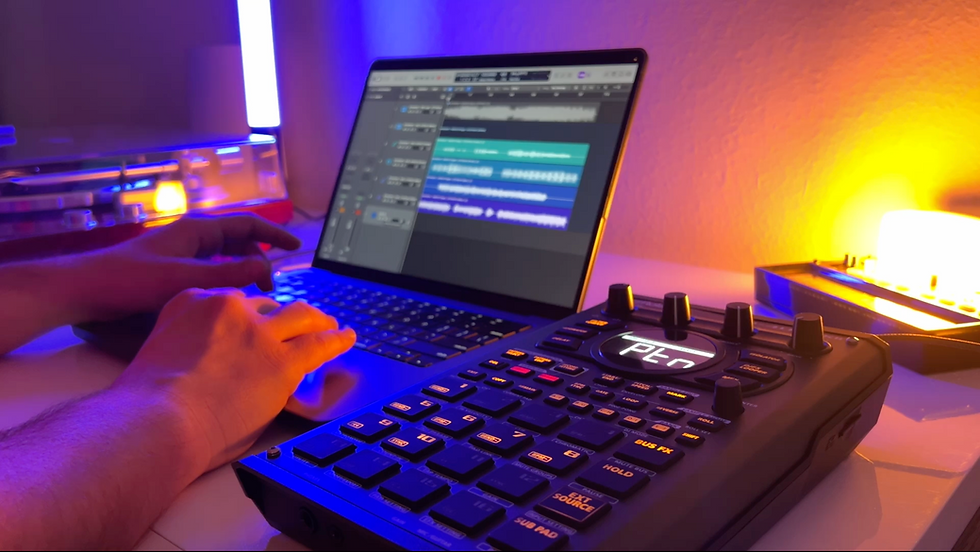
When to Expand Into a DAW
This is where I think a lot of discussions around hardware and software miss the point. I don't believe DAWs kill creativity. In fact, I use one on virtually every finished release. The difference is that I prefer to bring those tools into the process after the core idea already exists.
Once a groove, melody, or progression is established, the role of the DAW changes entirely. Instead of searching for inspiration, you're solving specific problems. Maybe the song needs a live guitar part. Maybe it needs vocal layers, stem separation, arrangement changes, or more detailed mixing. At that point, the additional options aren't creating decision paralysis because the song itself is providing direction.
I've found that this shift in mindset makes a huge difference. The DAW becomes a place to develop ideas rather than discover them. Because the foundation already exists, the abundance of tools feels empowering instead of overwhelming.
Start Small, Expand Later
My workflow today is surprisingly simple. I try to begin on the smallest device possible, whether that's a sampler, a groovebox, or a single instrument. The goal isn't to finish an entire track there. The goal is to get past the blank page as quickly as possible and capture the core idea before overthinking takes over.
Once that foundation exists, I have no problem expanding into larger tools and more complex workflows. By that point, the song usually tells me what it needs. Instead of facing an infinite number of possibilities, I'm making targeted decisions in service of an idea that's already alive.
The point isn't that limited gear is better than a DAW. It's that creativity and decision-making aren't always the same thing. Sometimes the fastest path to finishing more music is giving yourself fewer choices at the beginning and more choices later.
Music Making Resources
Free Sampler Starter Kit
Learn chopping, performance techniques, and beatmaking workflows for any sampler.
Get it free when you sign up for my monthly beatmaking newsletter:
Sample Packs
Original recordings made for sampling, chopping, resampling, and turning into something entirely your own.
Personalized Coaching
One-on-one help with beatmaking, music production, workflow development, and finishing tracks:


I appreciate this post, but I'd like to say, I think the more options and features available, the more you can do. If I told you to paint a scene of a house on a lake with either paint of all colors of the spectrum, or just black, which would you prefer? Sure, there's great black and white art, but when you have a larger tapestry of color it's that much better. The same applies to music in my humble opinion. I want as many features, sounds, and plugins that I can get my hands on to make music if I can. I've been slacking on music lately due to some personal issues, but I'm glad I have my MP…