
Why Every Producer Should Try Making Music from Field Recordings

Before a recent trip to Hawaii, I made a decision that felt a little risky. Instead of packing one of my samplers, I brought only my iPad and challenged myself to make an entire track using field recordings from the island. Every drum, every melodic sound, and every texture would have to come from something I recorded myself.
At first, it felt like I was leaving behind the tools I normally rely on. By the end of the project, though, I realized I hadn't limited my creativity at all. If anything, I had expanded it. The experience reminded me that making music isn't really about having more gear. It's about learning to hear the world around you as a collection of instruments waiting to be discovered.
How Field Recordings Can Transform Your Music Production
One of my favorite things about field recording music production is that it completely change how you experience everyday sounds. Instead of walking through the world passively, you start wondering what everything might become. A crashing wave isn't just a wave anymore. A coconut isn't just something you drink from. A stick hitting a tree, footsteps on a path, or the sound of birds in the distance all become potential source material.

That shift in perspective is incredibly inspiring because it gets you to think like a sound designer instead of simply searching for another preset. Every recording becomes a creative puzzle.
I think that's one of the reasons field recording has remained such an important part of my workflow. It encourages curiosity, and curiosity almost always leads to better creative decisions.
Turning Nature Into Instruments
As I explored Hawaii, I recorded anything that caught my attention. Ocean waves, coconuts, sticks, and ambient sounds from the trails all found their way into my project. Back at the iPad, those recordings became the raw material for an entirely new set of instruments.
One of my favorite moments came from the ocean itself. Using BLEASS Spectral Resonator (this project was created in partnership with BLEASS), I transformed recordings of the waves into evolving synth pads and ambient textures. It didn't sound anything like water anymore, but it still carried some of the movement and atmosphere of the original recording. That became the emotional foundation of the track.

The percussion came together in a similar way. A coconut became the kick drum, while other recordings were shaped into percussion and rhythmic textures. None of the sounds were designed to be instruments originally, but with a little processing and experimentation they took on entirely new roles.
The effects that made the biggest difference for the percussion were surprisingly simple. EQ helped shape and emphasize the frequencies of each "drum," saturation brought out additional harmonics and grit, and filters helped carve each sound into its own space.
That's one of the things I love most about sampling. You're not simply copying sounds. You're transforming them into something they were never intended to be.
Why I Didn't Finish the Song in Logic
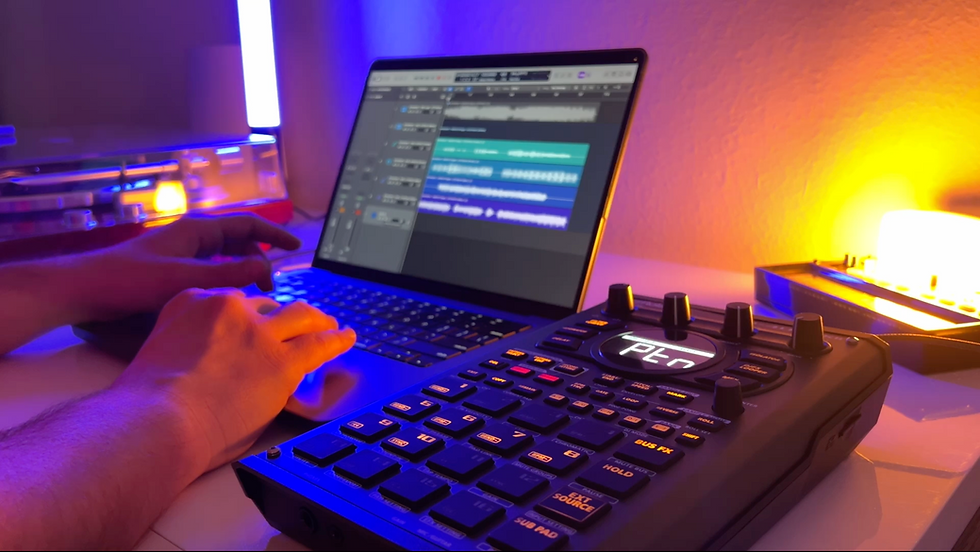
I started the project in Logic for iPad because it was the perfect place to turn my recordings into playable instruments. Between the sampler and the available effects, I could shape the raw recordings into something musical without much trouble.
Once the sounds were ready, though, I found myself wanting a different environment for actually writing the song.
As powerful as Logic is, it's still a full DAW. There are windows, menus, editing tools, and countless creative possibilities competing for your attention. I've written before about what I call the "blank page problem," where having too many options at the start of a session can actually make it harder to create. This project reminded me of that lesson all over again.
So I exported my newly created samples into Koala Sampler instead.
Koala Sampler for Beatmaking
The moment the samples were inside Koala, the workflow became much more immediate. Instead of thinking about tracks, plugins, and editing windows, I was simply chopping, pitching, sequencing, and experimenting.

Koala's Chopper feature made it incredibly easy to slice longer recordings into playable pieces, and from there I could quickly repitch sounds, build melodies, and rearrange ideas until they started feeling like a song. Rather than getting distracted by production decisions, I was focused on discovering what the samples wanted to become.
That simplicity is one of the reasons I keep coming back to dedicated samplers, whether they're hardware or software. They encourage experimentation without overwhelming you with choices. Once the core idea exists, I can always move into a larger production environment later if the song calls for it.
Creativity Comes Before Gear
It's tempting to want to buy the latest sampler or synthesizer. Those tools can absolutely be inspiring, but this project reminded me that inspiration doesn't come from the hardware itself.
The most creative part of this entire process wasn't using an iPad or discovering a new plugin. It was deciding that an ocean wave could become a synth, or that a coconut could become a kick drum. With that thinking in mind, almost anything around you becomes potential source material.
That's a mindset you can take into any workflow. Whether you're using Koala Sampler, a hardware sampler, or a full DAW, the most important skill isn't collecting more gear. It's learning to hear possibilities in sounds that most people would simply walk past.
A Creative Challenge Worth Trying
If you've been feeling stuck lately, try leaving your normal sample library behind for a day. Grab your phone, head outside, and record five sounds that catch your attention. Then build an entire beat using nothing but those recordings.
The finished track doesn't have to be perfect. That's not really the point.
The exercise forces you to listen more carefully, think more creatively, and solve musical problems in ways that browsing another preset library never will. You may even discover that your favorite sample pack has been sitting just outside your front door the whole time.
Music Making Resources
Free Sampler Starter Kit
Learn chopping, performance techniques, and beatmaking workflows for any sampler.
Get it free when you sign up for my monthly beatmaking newsletter:
Sample Packs
Original recordings made for sampling, chopping, resampling, and turning into something entirely your own.
Personalized Coaching
One-on-one help with beatmaking, music production, workflow development, and finishing tracks:
Comments