
MPC Sample Is Going Open Source? Here’s What It Means


Custom firmware has been one of the strangest music gear developments of 2026. Over the last couple of months, we’ve seen users add entirely new features to samplers and grooveboxes from Roland, Elektron and others, often without any involvement from the companies that originally made them.
Now Akai appears to be taking a very different approach. With the recent news, it seems the company may be actively embracing it, and that includes opening up both its upcoming Sample Key and the existing MPC Sample to community development. That could end up being a pretty big deal for a $400 sampler.
What Does “Open Source” Actually Mean?
At its simplest, open-source software makes its underlying code available so other developers can inspect it, modify it and potentially build their own versions or features on top of it. Exactly what people are allowed to do depends on the license and on which parts of the software a company actually releases.
That last part is important here. Unlike Behringer's KICK prototype, Akai has not yet published a source-code repository, license or detailed technical documentation explaining exactly which parts of the MPC Sample software will become open source. So while Akai is claiming to open the platform to community development, we don’t yet know whether that means the entire operating system will be publicly available or whether developers will work through a combination of open-source components and an SDK.
An SDK, or software development kit, gives developers documented tools for building software for a platform. That can still open the door to completely new instruments, effects and workflows without necessarily exposing every line of code inside the original operating system.
What Akai Actually Announced
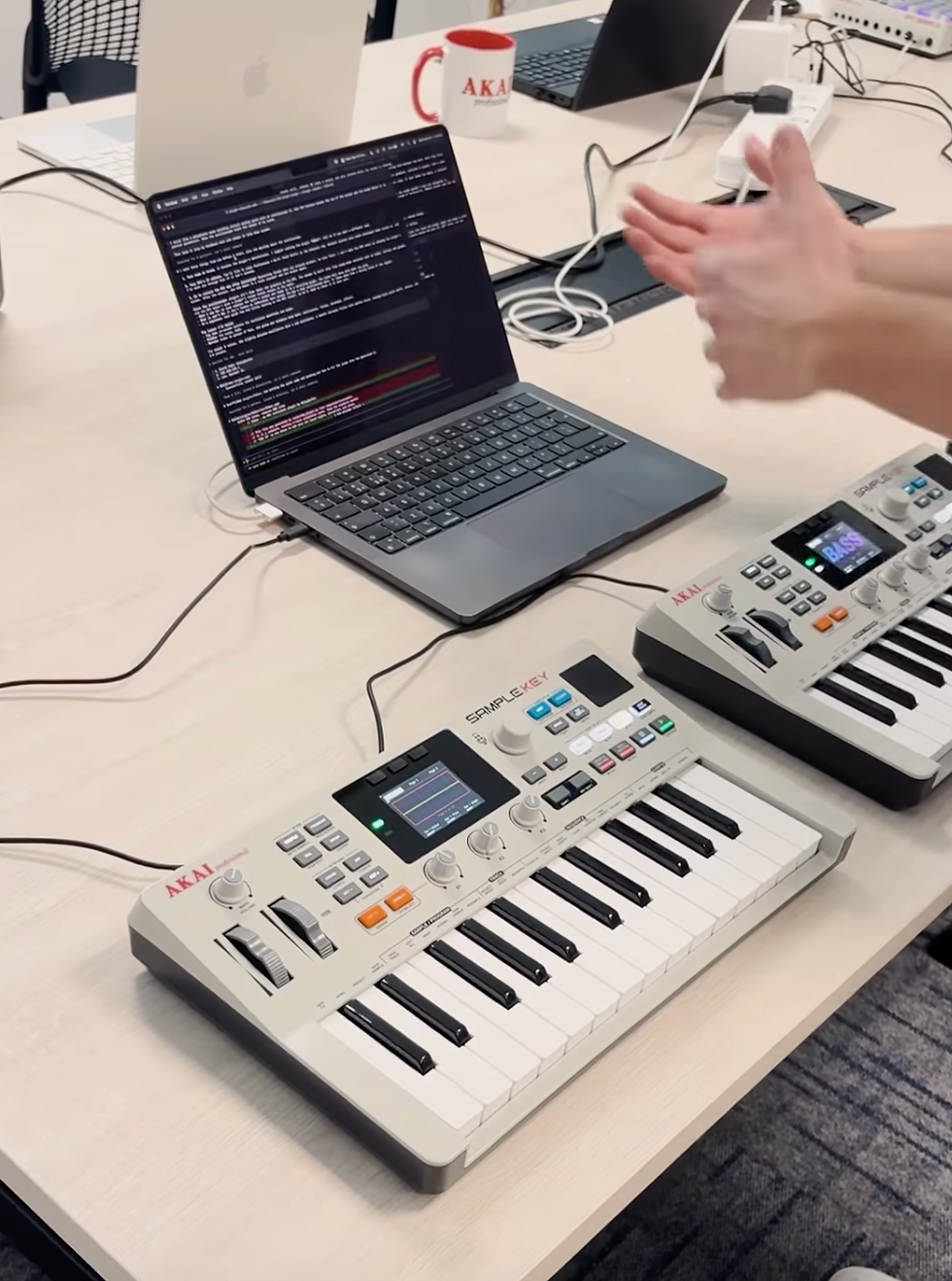
The whole thing started with Akai teasing a new keyboard-based version of the MPC Sample called Sample Key. Sample Key has not received a traditional full product announcement yet, but Akai has already been showing prototypes and early community modifications on its social channels. The company describes Sample Key as something that “can be whatever you want.”
The demonstrations go well beyond changing colors or adding a couple of menu options. Akai has shown developers using AI coding tools such as Claude to create new synthesizers for the hardware, including virtual-analog and FM-style instruments, while another demonstration showed a completely custom operating system containing multiple synths.
The important part for existing MPC Sample owners came next in the video. Akai also showed the regular MPC Sample running community-built synthesizers and confirmed that the same kind of community-development functionality being demonstrated on Sample Key is coming to the MPC Sample as well.
So this is not simply someone discovering an exploit and hacking into an MPC. Akai is intentionally giving developers a supported path to build new things for the hardware.
What Could This Mean for the MPC Sample?
I’ve spent quite a bit of time with the MPC Sample, and I like a lot about it. Chopping samples is fast, the basic workflow feels immediate and it manages to capture a lot of what makes an MPC fun without trying to squeeze the entire modern MPC platform into a tiny box.
At the same time, there are some workflow decisions that I would love to see changed. There’s no traditional 16-step sequencer interface, and even small things like Erase and Copy sharing the same physical button can add unnecessary friction.
This is where community development could become far more interesting to me than simply adding another synthesizer.
If developers are given enough access to the sequencer and user interface, we could potentially see completely different sequencing workflows, alternative shortcuts, new editing tools or features Akai may never have prioritized itself. One developer could focus on turning the Sample into more of a traditional step-sequencing groovebox, while someone else might build an entirely different sampling workflow.
And of course, the synth demonstrations show another possibility. The MPC Sample could become a platform for completely new sound engines, effects and instruments that were never part of Akai’s original design.
How far that can actually go will depend entirely on what Akai exposes through the open-source release and SDK, so I wouldn’t assume every part of the device will suddenly be customizable. But even a limited officially supported development environment could dramatically expand what this little sampler can do.
This Is Very Different From Unofficial Custom Firmware
Projects like DOOM OS and Freakier Firmware for the SP404 MK2 exist because independent developers figured out how to modify hardware that was never designed around community development. The results have been impressive, but they also involve reverse engineering and come with the risks you would expect from installing unofficial firmware.
Akai appears to be approaching the same movement from the other direction. Instead of waiting for people to break into the hardware, it is giving developers tools and apparently planning to expose at least parts of the software intentionally. That could make experimentation considerably more accessible. Developers don’t necessarily have to spend months reverse engineering a device before they can start building something useful, while regular users may eventually have a much clearer path for installing community-created features.
It also raises an interesting question about where music hardware goes from here. Behringer recently showed its upcoming KICK sampler with an open-source approach of its own, and now Akai is publicly embracing community development on one of its newest and most affordable devices.
If that approach works, the idea that the features you get when you buy a piece of hardware are the features you’ll always have may start feeling increasingly outdated.
Want to keep up with what's happening in music gear?
There are always so many releases and gear announcements that it can be hard to keep up. Join my monthly newsletter to stay up to date with the announcements that matter, along with gear updates and beatmaking tips. You'll also get a free sample pack when you sign up, and a sample every month.
Sample Packs: https://soundsbysunwarper.bandcamp.com/


Comments